24 Youth Group Games & Fun Activities

Let\’s be real β€” keeping a group of energetic young people engaged is no small feat. Whether you\’re a youth pastor, a camp counselor, a teacher, or just a brave soul who volunteered to \”run the games,\” you know the struggle is absolutely real. One minute they\’re excited, the next they\’re bored, scrolling (mentally, at least) through their imaginary For You Page. So I put together this list of 24 youth group games and fun activities that actually work β€” tried, tested, and youth-group-approved. πŸ™‚
Whether you need ice-breakers, team-building games, high-energy outdoor runs, or calm indoor options, this list has you covered. Ready? Let\’s go!

Human Knot

The Human Knot is one of those classics that never gets old, and honestly, it’s a fantastic ice-breaker. Everyone stands in a circle, grabs two different people’s hands across the ring, and then β€” without letting go β€” tries to untangle the human pretzel they’ve created. Sounds simple? Oh, it absolutely is not. But that’s the magic. The chaos forces communication, laughter, and genuine cooperation among kids who might barely know each other.
IMO, this game hits differently when you mix age groups. Watching an 11-year-old confidently direct a 16-year-old through a shoulder-over-head move is pure gold. Set a timer to add pressure, or run multiple rounds to see if the group improves. The best part? Zero equipment, zero prep, maximum fun. Every youth leader should have this one locked and loaded in their back pocket

Capture the Flag

If you want to see young people turn into absolute strategy generals in under five minutes, throw a game of Capture the Flag at them. Split into two teams, each defending its flag on opposite sides of a field. The goal? Sneak into enemy territory, grab their flag, and make it back alive β€” or at least without getting tagged. It’s equal parts sprinting, sneaking, and screaming your teammates’ names.
Ever wondered why this game has endured for decades in youth programs? Because it genuinely works for every energy level. The fast kids sprint. The strategic kids plan the offense. The sneaky kids flank from the left. Everyone has a role, everyone feels useful, and the whole thing is a masterclass in teamwork that the kids don’t even realize they’re learning. FYI, glow-in-the-dark flags make the nighttime version absolutely legendary.

Blob Tag

Blob Tag is a regular tag β€” but better, weirder, and way more hilarious. One person starts as “the blob” and tags others. Each new person joins the blob by holding hands, creating an ever-growing chain of giggly kids trying to corner their prey. As the blob grows, coordination becomes the biggest challenge. You’ve got eight people linked at the hands trying to pivot left while the person on the end is basically running backwards.
This game is perfect for large groups because literally everyone ends up in the blob eventually. It\’s also a sneaky great way to get shy kids physically connected with their peers in a totally non-awkward way. The laughter generated in the final minutes β€” when the blob is 20 people wide β€” is genuinely priceless. Best played on grass. Trust me, try it on concrete once and you’ll understand instantly.

Dodgeball Tournament

Dodgeball. The game that somehow makes everyone feel like a movie hero for at least five seconds. Organize a round-robin dodgeball tournament with multiple teams competing for the crown. This structure keeps everyone involved β€” even eliminated players cheer for teammates. Add custom rules like “catch = one teammate revives” to keep the energy constantly shifting. It’s chaotic in the best possible way.
The tournament format genuinely builds community. Kids who barely talk on Monday are full-on strategizing together by Wednesday. I’ve seen introverted teens completely come alive the moment that first ball sails across the gym. A little friendly competition is healthy, and dodgeball delivers exactly that rush. Keep the rules fair, rotate referees, and always β€” always β€” have foam balls, not the ones that leave a mark the shape of Texas.

Scavenger Hunt

A well-designed scavenger hunt is one of the most versatile games in your arsenal. You can theme it around your location, your group’s interests, or even a lesson you want to reinforce. Split kids into small teams and send them off with a list of clues or items to find. The first team back with everything wins. It sounds straightforward, but watching teams debate clue interpretations is basically free entertainment for leaders.
What I love most about scavenger hunts is how naturally they build problem-solving and communication skills. Every team has a navigator, a clue-reader, a photographer (for photo-based hunts), and usually one person who confidently leads everyone in the wrong direction. Add a photo challenge component β€” “take a selfie with something taller than your leader” β€” and the creativity explodes. This one scales beautifully from 10 kids to 100

Minute-to-Win-It Challenges

Minute-to-Win-It is basically a game show you bring to your youth group, and it absolutely slaps. Players have exactly 60 seconds to complete ridiculous tasks β€” move cotton balls with a spoon, stack Oreos on your forehead, blow a cup off a table using only a balloon. Each challenge is hilarious to watch and weirdly stressful to participate in. The crowd’s energy builds fast, and the group starts cheering each other on almost instantly.
These challenges work indoors with minimal setup, which makes them a go-to for rainy days or winter sessions. They’re great for mixing participants β€” you can run individuals, pairs, or relay-style. The real beauty of Minute-to-Win-It is how it creates equal opportunity for wins. The kid who’s never athletic might absolutely destroy the cookie-on-forehead challenge. I guarantee at least three people leave claiming it as their “hidden talent

Freeze Dance

Don\’t sleep on Freeze Dance just because it sounds like a kid’s birthday party staple. When you play high-energy music and challenge teens to out-weird each other’s frozen poses, the game takes on a whole new life. Add elimination rounds where the leader judges the most creative freeze pose. Suddenly, everyone’s trying to one-up each other with increasingly dramatic, theatrical statues. The competitive edge turns a simple concept into pure comedic gold.
Freeze Dance is also an excellent energy reset tool. Use it between intense activities to bring the group back to a manageable level of chaos. The music acts as a natural regulator β€” high BPM gets everyone hyped, slower tracks calm things down. I’ve used themed music (movie soundtracks, K-pop, 80s classics) to make it extra memorable. Pro tip: the leader dancing is non-negotiable. You signed up for this.

Two Truths and a Lie

Two Truths and a Lie is the ultimate ice-breaker for any group where people are still figuring each other out. Each person shares three statements about themselves β€” two true, one false β€” and the group tries to identify the lie. What makes it brilliant is how it encourages storytelling. The truths are often more surprising than the lies, and that’s where the real connection happens. You learn things about people you’d never think to ask.
I’ve facilitated this game with groups of strangers, and within 20 minutes, everyone’s invested in knowing more about each other. Give participants a few minutes to think before sharing β€” the best lies come from people who actually put thought into being believable. Keep the tone light and encourage wild truths. You’ll be amazed at what people have actually done. That kid who “seemed so quiet”? Skydived at 14. Classic.

Relay Races

Relay races are timeless, and the reason is simple β€” they work for every age, fitness level, and group size. Classic egg-and-spoon, three-legged race, wheelbarrow race, or the always-chaotic balloon-between-the-knees run. Layer these into a relay series, and you’ve got an activity that runs itself for a solid 30-45 minutes. Teams naturally start strategizing β€” who’s fastest, who handles the trickier legs, who rallies when someone fumbles.
The beauty of relay races is the collective investment. When one teammate drops the egg, the whole team groans and encourages β€” nobody laughs at the person, they rally around them. It builds exactly the kind of supportive team culture you want in your youth group. Add silly penalties for dropped items (everyone does five jumping jacks) to keep the energy high even during stumbles.

Improve Games

Improving games are secretly one of the most powerful tools in a youth leader’s playbook. Games like “Yes, And,” “Freeze,” and “Sound Ball” build communication skills, spontaneity, and the ability to laugh at yourself β€” things that are genuinely useful for the rest of life. Start simple: one person starts a scene, their partner says “yes,” and adds to it. The scene evolves based on pure improvisation. It sounds terrifying, but the laughter makes it safe.
What improv does better than almost any other activity is create psychological safety. When “failing” at improv just means the scene goes somewhere weird and hilarious, kids stop fearing mistakes. That mindset shift is massive for young people. I’ve watched the shyest kid in the room absolutely steal the show during improv β€” because the game rewarded creativity over perfection. Use these for groups that need to loosen up or whenever silence is getting awkward

Tug of War

Tug of War is pure, unfiltered competitive joy. You grab a rope, you pull with everything you\’ve got, and whoever crosses the line wins. That’s it. There’s something primal and satisfying about this game that modern entertainment just can’t replicate. Make it interesting by running it as a tournament, mixing team compositions between rounds, or adding a mud pit for the final round if you’re really committed to the bit.
The key to a great Tug of War session is fair team balancing. Don’t let all the biggest kids end up on one side β€” mix sizes, mix strengths, and let technique matter as much as power. The team that coordinates its pulls wins as often as the team with raw strength. It’s a beautiful physical demonstration of teamwork. Also, check the rope beforehand. You really don’t want a mid-pull snap situation.

Trivia Night

Trivia Night brings out a completely different kind of competitive energy β€” the brain kind. Mix categories: pop culture, sports, history, Bible trivia if that fits your context, and a wildcard round of “would you rather” style questions. Teams huddle, debate, and often discover they know way more than they thought. That moment when the quiet kid nails the obscure fact that wins the round? That’s a confidence builder right there.
Keep rounds short β€” 8-10 questions max β€” and move quickly between them to maintain the energy. Add a “steal” mechanic where teams can wager their points on bonus questions for extra drama. What I love most about Trivia Night is how it levels the playing field. Athletes, artists, bookworms β€” everyone brings value. It’s genuinely one of the most inclusive competitive formats you can run with a youth group.

Jenga with Dares

Take regular Jenga β€” already a masterpiece of tension β€” and write fun, age-appropriate dares or challenges on each block. Pull a block, read what’s written, complete the task. “Do your best celebrity impression. “Compliment everyone in the room. “Speak in an accent for the next two rounds.” The game becomes layered β€” you’re managing the structural challenge and the dare challenge. It’s brilliant and chaotic in equal measure.
This version works especially well for groups that already know each other a bit β€” the dares can get more personalized and funny. Keep the content genuinely appropriate; the goal is connection and laughter, not discomfort. Prepare your blocks in advance and add a few blank ones as wild cards (they choose their own dare). The tower collapse moment at the end, is always a dramatic, collective gasp that unifies the entire group instantly.

Paintball or Laser Tag

If budget allows, laser tag or paintball is the ultimate youth group outing. There\’s something about running through an arena with a mission that makes every participant β€” even the reluctant ones β€” go full operator mode. Laser tag is the safer, more accessible option for all ages. Paintball adds intensity for older groups (and yes, slightly more dramatic post-game war stories). Both build tactical thinking and team communication in a genuinely thrilling environment.
The real magic of these activities is that they create shared experiences that get talked about for weeks. That perfectly executed ambush your team pulled in round three? Still being quoted at youth group six months later. Debrief afterward and connect the teamwork moments to real-life principles. The kids don\’t realize you just turned laser tag into a leadership lesson, and frankly, that\’s exactly how the best youth programming works.

Water Balloon Fight

Never underestimate the power of a well-organized water balloon fight on a hot summer day. Set up bases, assign teams, and let the chaos unfold. The keyword there is organized β€” a structured battle is way more fun than a free-for-all. Add supply stations where teams can reload, safe zones for \”medical\” timeouts, and a point system for hits. Suddenly, it\’s a strategic water battle, and nobody knows how 45 minutes just disappeared.
Water activities break social barriers incredibly fast. People get splashed and laugh β€” it\’s impossible not to. The hierarchy of cool completely dissolves when everyone\’s equally soaked. Use rapid-fill water balloons if you want to prep efficiently; the self-tying ones are a genuine game-changer for leaders. Coordinate with parents for a change of clothes reminder. Speaking from experience: showing up to the post-game dinner completely drenched is… memorable, but also avoidable

Giant Board Games

Giant versions of classic board games β€” Connect Four, Chess, Checkers, Snakes and Ladders β€” transform familiar fun into group spectacles. When the pieces are person-sized, everyone becomes invested. Players move actual blocks, slide giant discs, and audiences watch strategy unfold in real time. These games are fantastic for events where you want activity stations running simultaneously β€” they hold attention without requiring active facilitation every second.
Giant board games are also surprisingly inclusive. They don’t require athletic ability, risk of physical contact, or split-second reflexes. The quiet, thoughtful kid who dreads dodgeball absolutely thrives here. Many sets are rentable for events or DIY-able with basic materials. A giant Jenga set made from 2×4 lumber costs maybe $30 to build and will get used at literally every youth group event for the next five years.

Campfire Story Circle

Not every great youth activity needs to be loud or physically intense. A campfire story circle is one of the most powerful bonding experiences you can create. Each person adds one sentence or one paragraph to a collaborative story, building something completely unexpected together. You can theme it β€” adventure, mystery, fantasy β€” or let it go wherever the group takes it. The results are always weird, always funny, always memorable.
There’s something about firelight and storytelling that drops everyone’s guard. I’ve seen genuinely meaningful connections form during campfire sessions that didn’t happen in months of “official” group activities. Transition from the collaborative story into personal shares or reflections if the atmosphere feels right. This activity also works indoors with battery-operated fire lights β€” not quite the same vibe, but surprisingly effective when outdoor fires aren’t an option.

Trust Walk

The Trust Walk pairs participants β€” one blindfolded, one guiding β€” and sends them through a simple obstacle course using only verbal directions. It sounds almost too straightforward to be powerful, but the experience hits differently than any explanation suggests. The blindfolded person learns to lean on their partner\’s voice. The guide learns to give clear, patient instructions. Both learn something real about vulnerability and responsibility.
Debrief immediately after and let the group reflect on the experience. \”What did it feel like to not be able to see?\” \”How did you build confidence in your guide?\” These questions open conversations about trust, leadership, and relationships that go way beyond the game itself. Pair people who don\’t know each other well for maximum impact. This is one of those activities that kids often bring up years later as something that genuinely stayed with them.

Art Jam

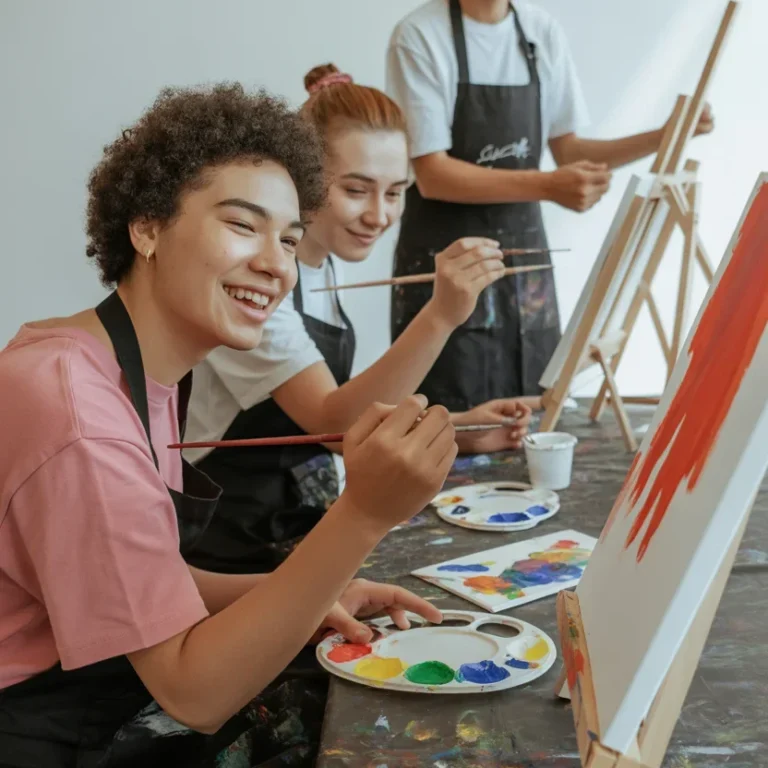
An Art Jam is the perfect alternative for groups with creative energy that doesn\=’t come out on a sports field. Set up supplies β€” canvas, watercolors, markers, clay, collage materials β€” and give a loose theme or complete creative freedom. Put on a playlist, step back, and let the creativity flow. no judgment, no competition, no “right” way to do it. The result is a roomful of people genuinely absorbed in something meaningful to them.
Art Jams reveal personality in fascinating ways. The perfectionist paints carefully. The free spirit throws paint at the canvas. The class clown creates something surprisingly profound. Display everyone’s work at the end and do a gallery walk β€” let people guess who made what. This creates connection through creative identity and gives everyone a moment of being genuinely seen and appreciated. It’s one of my personal favorite activities for deeper community building.

Cooking Challenge

A Cooking Challenge β€” think mini MasterChef meets youth group chaos β€” is a genuinely fantastic team activity. Give each team the same set of basic ingredients and 20-30 minutes to create the best dish possible. Set judging criteria: taste, presentation, creativity. The results range from genuinely impressive to… ambitious. Either way, everyone eats something, which is a great secondary benefit that youth groups always appreciate.
Cooking together fast-tracks relationship building in a way that few activities can. It’s collaborative, high-pressure, and ends with a shared product everyone made together. The life skill component is a genuine bonus β€” many teens have surprisingly limited cooking experience. Adapt the challenge to your space: full kitchen, camping stove, or even a no-cook “sandwich architecture” competition. Yes, I’ve done the sandwich one. Yes, it was ridiculous. Yes, everyone loved it

Talent Show

A youth group Talent Show is one of those events that becomes legendary in the group’s history. Give kids a week’s notice and a simple sign-up sheet. The acts range from genuine musical talent to interpretive dance to magic tricks that don’t quite work β€” and all of it is wonderful. Create a warm, supportive audience atmosphere from the start. When the group cheers loudly for every act, regardless of polish, something beautiful happens: kids take creative risks they normally wouldn’t.
The talent show also reveals gifts in unexpected people. The kid you thought was just the class clown writes and performs an original song. The athlete does a spoken word piece. These moments of self-expression are genuinely significant for young people forming their identities. Run it as an uncompetitive showcase β€” no winners or losers, just celebration of each person’s unique offering. Add some leader acts to normalize vulnerability and set a fun, safe tone.

Community Service Project

Sometimes the best “game” isn’t a game at all β€” it’s working together toward something that genuinely matters. Organize a community service project: neighborhood cleanup, mural painting, meal packing for a food bank, or visiting elderly residents. The shared mission creates instant unity. Young people β€” especially teens β€” respond deeply to being trusted with real responsibility and real impact. The pride that follows genuine service is different from any trophy.
Make sure the project has a visible, tangible result whenever possible. Planting a garden, building a bench, painting something permanent β€” these outcomes give kids something to point to and say, “We did that.” Debrief with reflective conversation afterward: what did you notice? How did it feel? What would you want to do more of? Service projects that end with genuine discussion about impact shape character in ways that go far beyond any game, and that’s precisely the point.

Movie Night with Discussion

A Movie Night becomes a genuinely rich group experience when you build in intentional discussion afterward. Pick a film with themes relevant to your group β€” resilience, identity, belonging, justice β€” and let it do some of the heavy lifting for you. Provide snacks, create a cozy atmosphere, and let everyone decompress while watching. The conversation that follows a well-chosen film can go places that a planned discussion never reaches naturally.
The key is your debrief questions. Not “did you like it?” but “which character did you relate to most and why?” or “what moment surprised you?” These questions open authentic sharing. Movie Night also works perfectly as a wind-down event at camps or retreats. It’s lower energy, inclusive of every personality type, and still deeply relational when facilitated well. Keep the film age-appropriate and preview it yourself first. Yes, that means you watch a movie as part of your prep work. You’re welcome.

Campout or Overnight Retreat

The campout or overnight retreat is the crown jewel of youth group activities. Nothing builds community faster than shared exhaustion, shared meals, shared late-night conversations, and the shared experience of waking up in the same place. Even a simple backyard campout strips away screens and schedules and creates space for real connection. Combine it with activities from this list β€” campfire story circle, trust walks, talent show β€”, and you’ve created something genuinely transformative.
Overnights let relationships deepen in ways that weekly meetings simply can’t. The “3 am conversation” phenomenon is real β€” some of the most honest, meaningful sharing happens when the defenses are down, and the stars are out. Plan the structure, but leave plenty of unstructured time. Kids need space to just exist together without an agenda. In my experience, the spontaneous moments of an overnight become the memories that last decades. Bring extra marshmallows. Always.

Final Thoughts: Go Make Some Memories

There you have it β€” 24 youth group games and activities that range from wildly energetic to quietly profound. The truth is, the best activity is the one your specific group needs in that specific moment. Sometimes that\’s a water balloon fight. Sometimes it\’s a trust walk followed by a campfire. The games are tools β€” but what you\’re really building is connection, trust, and belonging.
Start with one or two from this list this week. Watch what happens when young people are given space to play, create, compete, and serve together. The screen time drops